
Guardianship vs. Healthcare Proxy and Power of Attorney: What New York Families Need to Know
Guardianship vs. Healthcare Proxy vs. Power of Attorney in New York: Understanding Your Options Before a Crisis Occurs
One of the most common conversations I have with families is about what happens when a loved one can no longer make decisions for themselves.
Whether the cause is Alzheimer's disease, dementia, Parkinson's disease, a stroke, a traumatic brain injury, a developmental disability, or another medical condition, families are often surprised to learn that simply being a spouse, child, sibling, or close family member does not automatically give someone the legal authority to make decisions on another person's behalf.
Unfortunately, many families do not discover this until they are already facing a crisis.
A son may attempt to access his mother's bank account to pay bills and discover he has no authority to do so. A daughter may attempt to arrange home care services for her father and learn that medical providers cannot discuss his care. A spouse may need to apply for Medicaid benefits to pay for long-term care only to realize that no valid legal documents are in place.
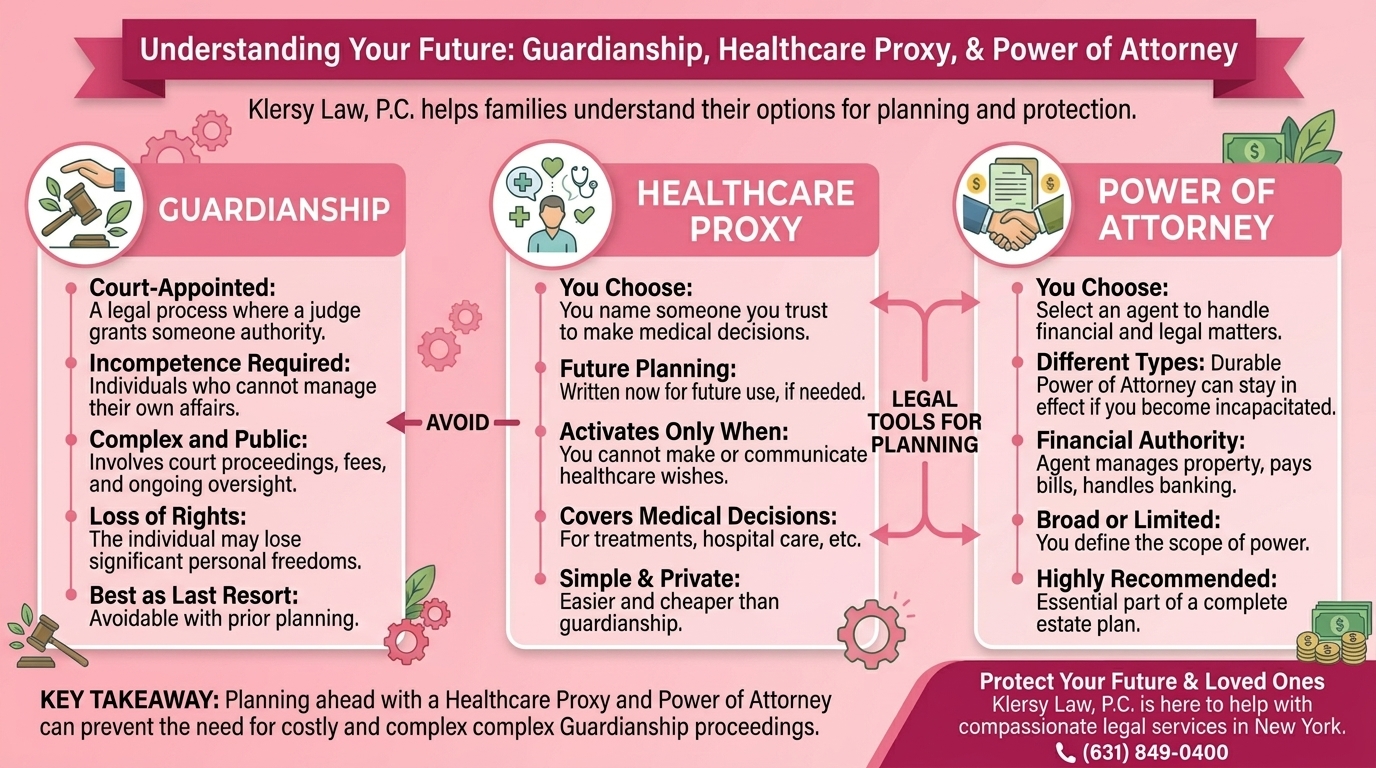
In New York, there are three primary legal tools used to address incapacity and decision-making:
• Healthcare Proxies
• Durable Powers of Attorney
• Guardianships
While these tools share a common goal—ensuring someone can step in and help when an individual cannot help themselves—they function very differently and serve different purposes.
Understanding the differences between a Healthcare Proxy New York, a Power of Attorney New York, and an Article 81 Guardianship New York can help families make informed decisions and avoid costly legal proceedings in the future.
As a New York Elder Law Firm, we help families throughout Suffolk County, Nassau County, Queens, Brooklyn, the Bronx, Manhattan, and across Long Island create comprehensive incapacity plans that protect both their loved ones and their assets.
Why Incapacity Planning Is One of the Most Important Parts of Estate Planning
Most people associate estate planning with preparing a Last Will and Testament. While wills are certainly important, many people do not realize that incapacity planning is often even more critical.
A will only becomes effective after death.
A healthcare proxy and durable power of attorney help protect you while you are still alive.
Without proper incapacity planning, your family may find themselves unable to:
- Access bank accounts
- Pay household bills
- Manage investments
- Sell or refinance real property
- Apply for Medicaid
- Arrange home care services
- Make medical decisions
- Obtain medical records
- Coordinate nursing home placement
- Protect assets from nursing home costs
In many situations, the absence of proper planning leaves guardianship as the only available option.
While guardianship can be an effective solution when necessary, most families would prefer to avoid the emotional, financial, and legal burdens associated with court proceedings.
This is why comprehensive Estate Planning Attorney Long Island services should always include advance directives such as healthcare proxies and powers of attorney.
What Is a Healthcare Proxy in New York?
A Healthcare Proxy New York is a legal document that allows you to appoint a trusted individual to make medical decisions on your behalf if you become unable to make those decisions yourself.
The person you appoint is known as your healthcare agent.
Many people mistakenly believe that their spouse or adult child automatically has authority to make healthcare decisions. While New York law does provide a hierarchy of potential surrogates under certain circumstances, relying upon statutory authority often creates unnecessary complications and family conflict.
A properly drafted healthcare proxy removes uncertainty by clearly identifying who you want making decisions if you become incapacitated.
When Does a Healthcare Proxy Become Effective?
A healthcare proxy does not take away your rights.
You remain completely in control of your medical decisions for as long as you have capacity.
The healthcare agent's authority generally begins only after a physician determines that you are unable to understand, evaluate, or communicate healthcare decisions.
Until that time, the healthcare proxy remains dormant.
This allows individuals to maintain independence while ensuring protection if their circumstances change.
What Decisions Can a Healthcare Agent Make?
Depending upon the language of the document, a healthcare agent may be authorized to:
- Communicate with physicians and healthcare providers
- Review medical records
- Consent to treatment
- Refuse treatment
- Arrange rehabilitation services
- Select healthcare providers
- Coordinate long-term care planning
- Arrange home care services
- Make decisions regarding nursing home placement
- Make end-of-life healthcare decisions
A healthcare proxy is often one of the most powerful gifts you can give your family because it provides clarity during some of life's most difficult moments.
What Is a Durable Power of Attorney in New York?
A Durable Power of Attorney NY is a legal document that authorizes another person to handle financial and legal matters on your behalf.
The person granted authority is referred to as your agent.
Unlike a healthcare proxy, which focuses on medical decisions, a power of attorney addresses financial affairs.
For many families, the power of attorney becomes the most important document in their entire estate plan because it allows loved ones to manage assets and engage in Medicaid Planning New York without requiring court intervention.
What Powers Can Be Granted Under a Power of Attorney?
A properly drafted power of attorney can authorize an agent to:
- Access bank accounts
- Pay bills
- Manage investments
- Conduct real estate transactions
- Sign contracts
- File tax returns
- Manage retirement accounts
- Apply for public benefits
- Handle insurance matters
- Manage business interests
- Engage in Medicaid asset protection planning
Because every family has unique needs, powers of attorney should be tailored to the individual's circumstances and goals.
Why Powers of Attorney Are Critical for Medicaid Planning
As a Medicaid Planning Attorney NY, one of the most common issues I encounter is a family attempting to obtain Home Care Medicaid or Nursing Home Medicaid benefits for a loved one who never executed a valid power of attorney.
Without proper authority, family members may be unable to:
- Transfer assets
- Establish Medicaid trusts
- Complete Medicaid applications
- Obtain financial records
- Access accounts
- Conduct asset protection planning
This often forces families into an expensive guardianship proceeding before Medicaid planning can even begin.
When properly drafted, a power of attorney can save families thousands of dollars and months of delay.
What Is an Article 81 Guardianship in New York?
An Article 81 Guardianship New York is a court-supervised proceeding in which a judge appoints an individual to make decisions for a person who is unable to adequately manage their personal needs, financial affairs, or both.
Unlike a healthcare proxy or power of attorney, guardianship is not voluntary.
Instead, it requires a formal legal proceeding before the Supreme Court.
The court must determine whether the individual is incapacitated and what level of assistance is necessary.
When Is Guardianship Necessary?
Guardianship is often sought when:
- No healthcare proxy exists
- No power of attorney exists
- Existing documents are invalid
- Existing documents do not provide sufficient authority
- Financial exploitation is occurring
- Family members are engaged in disputes
- The individual refuses assistance despite obvious incapacity
- The appointed agent is abusing their authority
In these situations, guardianship can provide critical protections.
What Happens During a Guardianship Proceeding?
A guardianship proceeding generally involves:
- Filing a petition with the court.
- Serving all interested parties.
- Appointment of a Court Evaluator.
- Medical evidence regarding capacity.
- A court hearing.
- Judicial determination regarding the need for a guardian.
The court's goal is not simply to remove rights. Rather, New York law requires the court to impose the least restrictive form of intervention necessary to protect the individual.
Powers Granted to a Guardian
Depending upon the circumstances, a guardian may receive authority over:
Personal Needs
- Medical decisions
- Healthcare coordination
- Residential placement
- Home care arrangements
- Nursing home placement
Property Management
- Banking
- Investments
- Real estate
- Government benefits
- Medicaid applications
- Litigation matters
Unlike an agent acting under a power of attorney, guardians are subject to ongoing judicial oversight, annual reporting requirements, and court supervision.
Guardianship vs. Healthcare Proxy
Many families ask whether guardianship is necessary if a healthcare proxy exists.
In many cases, the answer is no.
A healthcare proxy is generally preferred because:
- The individual chooses their own agent
- No court proceeding is required
- No judicial supervision is necessary
- Costs are significantly lower
- Family conflict is reduced
However, guardianship may still be required when:
- No healthcare proxy exists
- The healthcare proxy is invalid
- Family members challenge the agent's authority
- The agent is failing to act appropriately
Guardianship vs. Power of Attorney
The same comparison applies when evaluating a Guardianship vs Power of Attorney situation.
A properly drafted power of attorney typically provides greater flexibility and significantly lower costs than guardianship.
However, guardianship may become necessary if:
- No power of attorney exists
- The power of attorney is defective
- The agent is abusing their authority
- Financial exploitation has occurred
- Court intervention is required to protect assets
For many families, a guardianship proceeding becomes a last-resort solution when advance planning was not completed.
Special Needs Planning and Guardianships
Families caring for loved ones with developmental disabilities face additional considerations.
Depending upon the individual's abilities and needs, planning may involve:
- Article 17-A Guardianships
- Article 81 Guardianships
- Supported Decision-Making Agreements
- Supplemental Needs Trusts
- Medicaid Planning
- SSI Planning
As a firm that handles Special Needs Planning New York, we work closely with families to determine which legal tools provide the greatest protection while preserving independence whenever possible.
How Klersy Law, P.C. Helps New York Families
At Klersy Law, P.C., we understand that conversations about incapacity, guardianship, and long-term care planning can be overwhelming. Families are often navigating some of the most difficult periods of their lives while trying to make decisions that will affect their loved one's health, safety, and financial security.
Our firm assists clients throughout Long Island and New York with:
- Healthcare Proxy New York documents
- Durable Power of Attorney NY documents
- Living Wills
- Estate Planning
- Elder Law Planning
- Medicaid Planning
- Medicaid Asset Protection
- Home Care Medicaid Applications
- Nursing Home Medicaid Applications
- Article 81 Guardianships
- Article 17-A Guardianships
- Special Needs Planning
- Trust Planning
- Probate and Estate Administration
Whether you are looking to avoid guardianship through proactive planning or need immediate assistance with a guardianship proceeding, our goal is to provide compassionate, practical, and effective legal guidance tailored to your family's needs.
Protect Your Family Before a Crisis Occurs
The best time to create a healthcare proxy, power of attorney, and comprehensive estate plan is before they are needed.
Proper planning can help avoid court involvement, reduce family conflict, preserve assets, and ensure that your wishes are honored if you become unable to make decisions for yourself.
If you have questions about guardianships, powers of attorney, healthcare proxies, Medicaid planning, special needs planning, or elder law matters in New York, contact Klersy Law, P.C. to schedule a consultation and learn how we can help protect your family's future.