
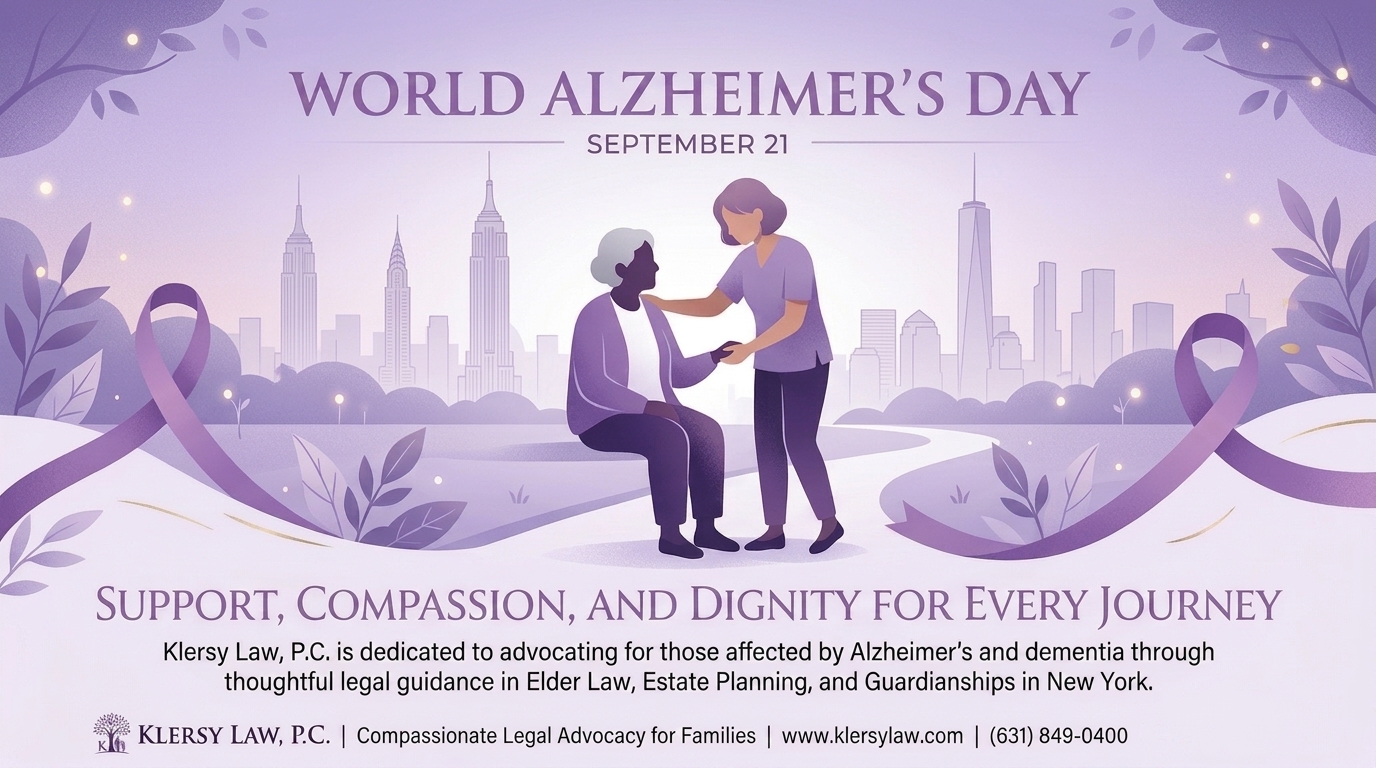
World Alzheimer's Day: Why Planning Today Can Protect Your Tomorrow
Every year on September 21, people around the world observe World Alzheimer's Day, a day dedicated to raising awareness about Alzheimer's disease and other forms of dementia, supporting those living with cognitive impairment, and encouraging meaningful conversations about planning for the future.
For many families, an Alzheimer's diagnosis is overwhelming. The news often brings uncertainty, fear, and countless questions about what lies ahead. While medical providers focus on treatment and quality of life, families are also faced with important legal, financial, and long-term care decisions that are often overlooked until a crisis occurs.
As an Elder Law Attorney serving Suffolk County, Nassau County, Queens, Brooklyn, the Bronx, Westchester County, and families throughout New York, I have seen firsthand how proper planning can provide stability during one of life's most challenging journeys. Although no legal document can prevent Alzheimer's disease, thoughtful estate planning, Medicaid planning, and long-term care planning can protect an individual's wishes, preserve assets, and reduce unnecessary stress for loved ones.
World Alzheimer's Day is not just about raising awareness—it is about encouraging action while individuals are still able to make informed decisions about their future.
Understanding Alzheimer's Disease
Alzheimer's disease is the most common form of dementia, affecting millions of individuals and their families worldwide. It is a progressive neurological disease that gradually impacts memory, reasoning, judgment, language, and the ability to perform everyday activities.
In the early stages, a person may simply experience occasional forgetfulness or difficulty recalling names and appointments. As the disease progresses, however, managing finances, understanding legal documents, making healthcare decisions, and safely living independently may become increasingly difficult.
Because Alzheimer's affects every individual differently, there is no way to predict exactly how quickly symptoms will progress. What remains consistent, however, is the importance of planning while the individual still has the legal capacity to make informed decisions.
Why Early Estate Planning Is So Important
One of the most common misconceptions I hear is, "We'll take care of the paperwork later."
Unfortunately, "later" sometimes comes too late.
Under New York law, a person must possess the legal capacity to understand the nature and consequences of signing important legal documents. Once Alzheimer's disease has progressed to the point where capacity is questioned, creating or updating estate planning documents may no longer be possible.
That means opportunities to appoint trusted decision-makers, protect assets, or express personal wishes may be lost.
Planning early allows individuals—not the courts—to decide who will manage their affairs, make healthcare decisions, and carry out their wishes if they become unable to do so independently.
Estate planning is not about expecting the worst. It is about ensuring that your voice continues to be heard even if one day you cannot speak for yourself.
Estate Planning Is About More Than a Will
Many people believe that estate planning begins and ends with drafting a Last Will and Testament. While a Will is certainly an important part of a comprehensive estate plan, it is only one piece of the puzzle.
For individuals diagnosed with Alzheimer's disease—or anyone preparing for the unexpected—a complete estate plan should address both lifetime incapacity and the eventual transfer of assets.
Durable Power of Attorney
One of the most important documents in any estate plan is a Durable Power of Attorney.
This document allows you to appoint someone you trust to manage financial and legal matters if you become unable to do so yourself.
Depending on the authority granted, your chosen agent may be able to pay bills, communicate with banks, manage investments, oversee real estate, file taxes, handle insurance matters, and assist with Medicaid planning if long-term care becomes necessary.
Without a valid Power of Attorney, even close family members often lack the legal authority to access accounts or make financial decisions on your behalf.
Health Care Proxy
A Health Care Proxy allows you to designate someone to make medical decisions if you lose the ability to communicate with your physicians.
Rather than leaving healthcare providers or family members uncertain about who should make decisions, this document clearly identifies the person you trust to advocate for your wishes.
For families navigating Alzheimer's disease, this can provide tremendous peace of mind during difficult medical situations.
Living Will
A Living Will works alongside a Health Care Proxy by expressing your preferences regarding medical treatment and end-of-life care.
While these conversations are never easy, documenting your wishes now can help relieve loved ones of the burden of guessing what you would have wanted during emotionally challenging circumstances.
Trust Planning
Many families also benefit from trust planning as part of their overall estate plan.
Depending upon your circumstances and goals, trusts may help streamline the administration of your estate, provide asset management, protect beneficiaries, avoid unnecessary probate proceedings, and assist with long-term asset protection planning.
Every family is different, making individualized legal advice essential.
Alzheimer's Disease and Long-Term Care Planning
One of the greatest financial concerns associated with Alzheimer's disease is the cost of long-term care.
Many individuals begin by needing only occasional assistance at home. As the disease progresses, however, additional support may become necessary through home health aides, adult day programs, assisted living communities, memory care facilities, or skilled nursing homes.
These services can cost thousands of dollars each month.
Unfortunately, many families mistakenly assume Medicare will cover these expenses indefinitely. While Medicare may provide limited coverage for rehabilitation or certain skilled services under qualifying circumstances, it generally does not pay for long-term custodial care.
This is where long-term care planning becomes critically important.
Working with an experienced Medicaid Planning Attorney before a crisis occurs may allow families to preserve assets while preparing for future care needs through legally appropriate planning strategies.
Beginning these conversations early often provides significantly more options than waiting until care is urgently needed.
Protecting Families From Future Conflict
An Alzheimer's diagnosis affects more than the individual—it affects the entire family.
Adult children frequently find themselves balancing careers, raising children of their own, and suddenly assuming caregiving responsibilities for aging parents. Decisions about finances, healthcare, living arrangements, and caregiving responsibilities can become emotionally overwhelming.
Unfortunately, when legal documents are missing or outdated, disagreements sometimes arise over who should make decisions or how assets should be managed.
Comprehensive estate planning reduces uncertainty by clearly documenting an individual's wishes before capacity becomes an issue.
Rather than leaving family members to guess, the law can recognize decisions that have already been thoughtfully made.
When Guardianship May Become Necessary
Unfortunately, not every family has the opportunity to plan ahead.
If an individual has already lost the capacity to execute legal documents and no valid Power of Attorney or Health Care Proxy exists, loved ones may need to petition the court for a guardianship.
Guardianship allows the court to appoint someone to make financial and personal decisions on behalf of an incapacitated individual.
While guardianship is an important legal safeguard, it is generally more expensive, more time-consuming, and more restrictive than proactive estate planning. Whenever possible, executing advance directives before they become necessary remains the preferred approach.
Conversations That Matter
One of the greatest gifts you can give your family is clarity.
World Alzheimer's Day is an excellent opportunity to begin conversations that many families postpone because they feel uncomfortable discussing illness or mortality.
Talk with your loved ones about:
- Who you trust to make financial decisions.
- Who should make healthcare decisions.
- Where you would prefer to receive care if possible.
- Your wishes regarding long-term care.
- Your goals for preserving family assets.
- The location of important legal documents.
Although these conversations may feel difficult today, they often prevent confusion, disagreements, and unnecessary stress in the future.
World Alzheimer's Day Is a Reminder to Review Your Estate Plan
Even if you already have an estate plan, it should be reviewed periodically.
Life changes. Families grow. Relationships evolve. Financial circumstances shift. Laws change. Health changes.
As a general rule, estate planning documents should be reviewed every few years or following major life events such as retirement, marriage, divorce, the birth of grandchildren, a serious illness, or the diagnosis of Alzheimer's disease or another cognitive condition.
A simple review can confirm that your documents continue to reflect your wishes and comply with current law.
Compassionate Planning for Every Stage of Life
At Klersy Law, P.C., we understand that planning for the future is about much more than legal documents. It is about protecting your dignity, preserving your independence, reducing burdens on your loved ones, and ensuring your voice continues to be heard.
Whether you are creating your first estate plan, updating existing documents following an Alzheimer's diagnosis, planning for Home Care Medicaid or Nursing Home Medicaid, or exploring asset protection strategies, our office is committed to providing compassionate, personalized legal guidance tailored to your family's unique needs.
Take the First Step Today
World Alzheimer's Day reminds us that while we cannot predict the future, we can prepare for it.
If you or a loved one has recently been diagnosed with Alzheimer's disease—or if it has simply been several years since your estate plan was reviewed—now is the time to act.
At Klersy Law, P.C., we proudly assist individuals and families throughout Suffolk County, Nassau County, Queens, Brooklyn, the Bronx, Westchester County, and across New York with estate planning, elder law, Medicaid planning, trust planning, guardianship, powers of attorney, and long-term care planning.
Contact our office today to schedule a consultation. Together, we can create a plan that protects your wishes, your loved ones, and your legacy—no matter what the future may hold.
Frequently Asked Questions
Can someone with early Alzheimer's still create an estate plan?
Possibly. A diagnosis of Alzheimer's disease does not automatically mean someone lacks legal capacity. If an individual understands the nature and consequences of the legal documents they are signing, they may still be able to execute or update an estate plan. Because capacity can change over time, it is important to consult with an experienced estate planning attorney as soon as possible.
Does Medicare pay for long-term Alzheimer's care?
Medicare may cover certain short-term skilled care and rehabilitation services if eligibility requirements are met, but it generally does not cover long-term custodial care. Many families eventually explore Home Care Medicaid or Nursing Home Medicaid as part of their long-term care planning.
Why is a Power of Attorney important after an Alzheimer's diagnosis?
A Durable Power of Attorney allows a trusted individual to manage financial and legal matters if the person with Alzheimer's becomes unable to do so independently. Without one, family members may need to pursue guardianship through the court.
How often should estate planning documents be reviewed?
Most estate planning attorneys recommend reviewing your estate plan every three to five years or after significant life events, including retirement, marriage, divorce, the birth of grandchildren, or a diagnosis of Alzheimer's disease or another serious illness.